

The Architecture of Decision Superiority: Inside Vannevar Labs’ Technical Ecosystem
By Buck Biblehouse – Senior Editor
Vannevar Labs is redefining the “OODA loop” (Observe, Orient, Decide, Act) by deploying a software-centric approach to modern conflict. By moving away from legacy hardware-first systems, the company has built an integrated ecosystem capable of processing massive data volumes to generate tactical advantages. At its core, the technology leverages agentic AI—autonomous software agents that can reason through complex scenarios—to provide intelligence that was previously buried under petabytes of noise.
The Foundation: Scalable Data Ingestion and Processing
The technological backbone of Vannevar Labs is its ability to ingest and normalize terabytes of unstructured data in real-time. This includes satellite imagery, radio frequency (RF) signals, maritime logs, and foreign-language open-source intelligence (OSINT).
- Decrypt & Decipher Platforms: These modules utilize advanced Natural Language Processing (NLP) and machine learning to translate and categorize adversarial data. Rather than simple translation, the system performs entity extraction and sentiment analysis at scale, allowing it to identify hidden connections within foreign military documents or technical journals.
- Data Lakes & Petabyte-Scale Analysis: The company maintains a proprietary repository of over 1 petabyte of adversarial data, growing by roughly 10 terabytes weekly. Their algorithms utilize this historical depth to train models that recognize “normal” patterns, making it possible to flag even the slightest anomalies in adversary behavior.
High-Fidelity Tactical Modeling: The “Boarding Scenario”
The technical demonstration at AFCEA highlighted the platform’s ability to transition from raw data to a functional Battle Plan. In the scenario of a suspicious vessel potentially carrying weapons, the software operates across multiple technical layers:
- Probability Modeling: The system aggregates physical sensor data (ship displacement, speed, and AIS signatures) against historical smuggling profiles. It calculates a “weapons probability score” by cross-referencing the ship’s origin, cargo weight discrepancies, and the digital footprint of the shipping company.
- Autonomous Tactical Planning: Once a threat is confirmed, the AI generates a multi-phase boarding plan. It evaluates sea state conditions, optimal approach vectors for U.S. boarding teams, and fuel consumption for support craft.
- Algorithmic Diversions: The most advanced feature is the AI’s ability to design asymmetric distractions. The system can identify specific “blind spots” in an adversary’s sensor network and suggest electronic or narrative diversions, such as localized signal jamming or the deployment of decoys, to mask the boarding team’s movements and saturate the adversary’s decision-making capacity.
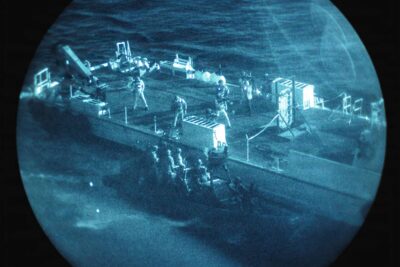
U.S. Marines with the Maritime Raid Force, 11th Marine Expeditionary Unit, board a target vessel during a visit, board, search and seizure exercise in the Pacific Ocean, Feb. 2, 2026. The 11th MEU is currently underway aboard the Boxer Amphibious Ready Group in the U.S. 3rd Fleet area of operations conducting integrated training that enhances lethality and warfighting readiness. (U.S. Marine Corps photo by Sgt. Joseph Helms)
Predictive Intelligence: Identifying Adversarial Presence
In a separate technical application, the software demonstrates its utility in counter-intelligence and pattern recognition. By analyzing attendee lists, visa records, and digital behavior, the platform can assess the likelihood of foreign agents infiltrating the US.
The technology utilizes graph analytics to map relationships between individuals and foreign intelligence apparatuses. It doesn’t just look for names; it analyzes career trajectories, institutional affiliations, and travel patterns to provide a probability-based assessment of espionage risk. This allows security personnel to prioritize monitoring efforts based on data-driven “threat scores” rather than manual guesswork.
The Shift to Software-Defined Warfare
Vannevar’s technical edge lies in Software-Defined Defense. By decoupling intelligence capabilities from specific hardware, their tools can be deployed to the “tactical edge”—meaning a soldier with a laptop or tablet can access the same computing power as a rear-command center. This architecture ensures that as adversarial tactics change, the software can be updated in hours, rather than the years required for hardware modifications.
The Scenario: Interdicting High-Value Illicit Cargo
Consider a scenario involving a “dark” vessel—a cargo ship that has disabled its Automatic Identification System (AIS) and is suspected of transporting advanced weaponry into a contested region. Traditionally, validating this threat would require days of human analysis across satellite imagery, port logs, and signal intelligence.
Vannevar’s Decrypt and Overwatch platforms automate this process by executing three distinct technical phases:
- Multi-Modal Anomaly Detection
The AI first pulls terabytes of historical data to establish a baseline for the vessel. It cross-references current satellite imagery with historical displacement data. If the ship is sitting lower in the water than its manifest suggests, the AI flags a high “Weapons Likelihood Score.” It then scrapes localized foreign language news and port communications data that Vannevar ingests at a rate of 10 terabytes per week—to find mentions of the ship’s crew or cargo that never made it into official English-language channels.
- The Automated Battle Plan
Once the threat is validated, the software transitions from analysis to agentic planning. It generates a comprehensive boarding plan for U.S. forces, calculating:
Optimal Intercept Points: Based on fuel consumption, sea states, and the ship’s projected path.
Risk Mitigation: Identifying the vessel’s internal layout from public blueprints to suggest the safest boarding entry points.
- Algorithmic Diversions and Deception
The most transformative feature of the Vannevar ecosystem is its use of AI-driven diversions. To ensure the U.S. boarding team retains the element of surprise, the AI analyzes the adversary’s sensor network and local communication nodes. It then suggests a series of distractions, such as non-kinetic electronic signatures or localized “information noise”, to draw the adversary’s attention to the opposite side of the vessel or a different sector entirely. This saturates the enemy’s cognitive bandwidth, forcing them to process false positives while the real operation commences.
The Technical Takeaway
For the COTS Journal reader, the significance of Vannevar Labs lies in software-defined defense. By leveraging petabyte-scale data lakes and agentic AI, they provide a capability that hardware alone cannot match: the ability to “see” a threat through the noise and “act” with a pre-calculated, diversionary strategy that protects American lives.