Building the autonomous infrastructure that will shape commerce, defense, and the future of off-world operations
By: Michael Santora, CEO, and Manit Ginoya, CTO at Logic
A technological race is underway that will shape global power and influence for decades. The next frontier of economic strength, national defense, and off-world expansion will not be defined by the nation that reaches space first, but by the nation that builds the logistics systems that make deep-space presence operational, repeatable, and commercially scalable. As space and defense operations enter their next era, autonomous supply chains and systems powered by robotics, AI, and autonomous freight represent the next fundamental infrastructure of global influence. The United States faces steep competition as foreign investments in this space mature quickly, revealing strategies that extend well beyond experimentation. The goal is not only to build autonomous systems that can perform individual tasks, but to establish end-to-end supply chain dominance across Earth, low-Earth orbit, lunar environments, and eventually Mars. While rapid progress by competing nations raises the stakes, it also provides a necessary benchmark for urgency. This clear measuring stick can help the U.S. calibrate both the speed and the scale of its own innovation efforts.
China is moving fast, and the structural advantages behind that momentum are real. The nation has a mature manufacturing base that can pivot quickly to new technologies, a large technical workforce trained in robotics and AI, and an already successful national space program. Beyond military dynamics, infrastructure will ultimately determine leadership. The country that builds the first scalable space supply chain will set the standards everyone else must adopt. When infrastructure is standardized, the rest of the world adapts. The shipping container clearly shows how one technology can lay the foundation for long-term industrial growth, reshaping ports, trucks, rail systems, and global trade around a single standard.
History shows that once a standard is established, it can persist for centuries. The width of modern railroad tracks, for example, traces back to wagon ruts set by the distance between two horses, a seemingly small choice that still influences, and sometimes limits, how we move critical infrastructure today. In the same way, ports and cities have rebuilt bridges and terminals to accommodate standardized container dimensions, literally reshaping their infrastructure around the logistics norms that were defined first.
The U.S. is not behind in innovation or talent. The challenge is that innovation is fragmented across industries that still rely on legacy equipment, legacy workforce structures, and legacy logistics systems. Engineers who could design next-generation robotics spend much of their careers maintaining outdated conveyor systems or retrofitting decades-old infrastructure, instead of building the next generation of autonomous platforms. If the U.S. remains structurally slow, it could enter a future where its commercial companies must rely on systems built by foreign competitors simply because those competitors built first. The space race is now a logistics race, and leadership will depend on the ability to streamline and expand automation into every node of the supply chain.
Why Autonomy is the Foundation of Off-World Expansion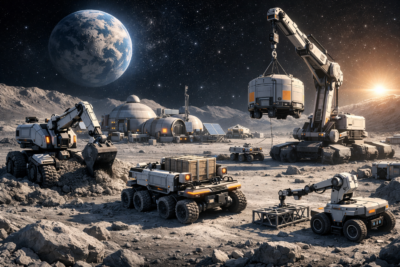
Constructing Moon bases, operating orbital fuel depots, or managing interplanetary shipping will not be done using manually operated systems. These applications require robotics, digital twins, and autonomous coordination platforms that can operate remotely, self-correct without human intervention, and maintain constant observability across the supply chain. Robots have been mechanically capable for decades; autonomy is what has changed. Software and robotic controls are now advanced enough to recover from failure, identify faults, and make decisions without manual reprogramming for every scenario. These capabilities will make lunar construction and orbital resupply both practical and scalable.
Critically, fully autonomous, high-stakes facilities in space cannot be practical unless we first prove the same level of autonomy across warehouses, ports, and defense logistics on Earth. The maturity of Earthbound automation will determine whether off-world operations are reliable, repeatable, and safe enough to support national security and commercial growth.
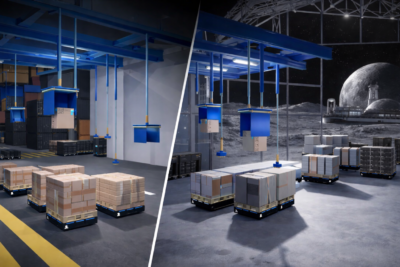
Future space operations will depend on a single, unified transportation system managed through one digital platform with a real-time view of every involved asset. Historically, transportation management systems were transactional tools used to find a carrier, compare prices, or route shipments. The next generation will be a logistics management layer that spans Earth-based, orbital, and lunar supply chains. In this model, a cargo load mined on an asteroid or manufactured on the Moon would not require a sequence of independent, incompatible logistics platforms to reach its destination. Instead, a single system would orchestrate robotic ground vehicles, autonomous drones, space-based transport, and warehouse systems within one supply chain architecture. This is the only model that can scale off-world infrastructure to the level required for sustained commercial and defense operations. Without autonomy that connects every vehicle, shipment, route, and facility into one continuous system, deep-space supply chains cannot exist.
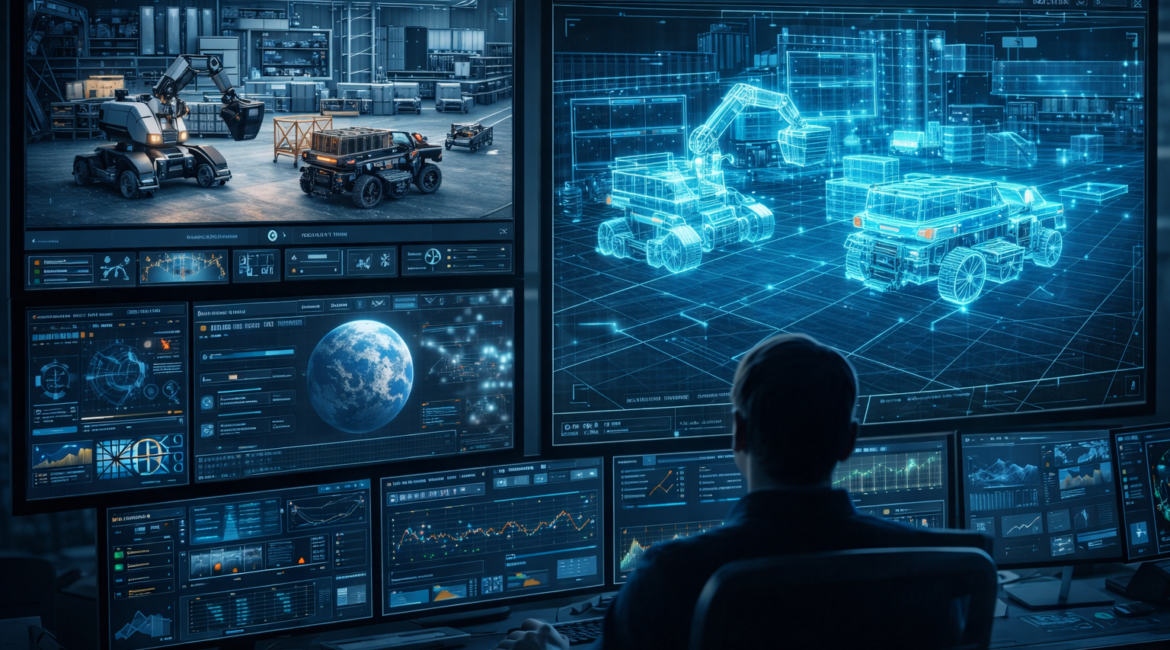
Digital twin systems will play a central role. They let operators observe a facility or vehicle’s state in real time, identify maintenance or safety risks, and control operations remotely. Most significantly, they enable logistics to be run without on-site personnel. In space, this is not merely advantageous. It is non-negotiable. Many facilities will never be visited in person. Those installations will require AI-enabled visibility, facility-level autonomy, and automated decision-making that can run operations robustly despite communication delays and environmental constraints.
For both defense and commercial missions, this level of visibility is also a security requirement. Reliable, AI-enabled observability across every node of the supply chain reduces blind spots, makes it harder for adversaries or failures to go undetected, and allows autonomous systems to respond to anomalies in real time, on Earth and in orbit.
 Standardizing the Supply Chain: What Logistics Teaches Us
History has repeatedly shown that logistics determines both economic and military outcomes. The U.S. recognized this in World War II, when palletized and containerized freight drastically accelerated deployments and military operations. That advantage came from coordination between U.S. industry and the defense sector. Because commercial manufacturers and the military essentially worked on a shared logistics model, the U.S. could move faster and operate more efficiently. Innovations such as the shipping container transformed not only how nations fought wars, but also how global industries designed ports, trucks, rail systems, and crews. Once a standard becomes ubiquitous, the world reshapes itself around it.
Today, the U.S. faces the same opportunity. Public-private alignment is the most practical path toward cementing leadership in this space. Startups must scale quickly, but only defense-grade partnerships can provide the required industrial infrastructure. Today, the challenge is less about inventing new solutions and more about scaling them rapidly into practice. That means reducing bureaucratic friction, creating repeatable pilot programs with ports, military bases, and aerospace facilities, and deliberately pairing high-velocity startups with established manufacturers that can build and deploy new platforms at scale. U.S. ideas and IP often stall because innovators struggle to access the manufacturing resources required to scale, validate, and deploy technology. China succeeds not because it has better ideas, but because it can convert ideas into deployment at enormous speed. To stay competitive, the U.S. must accelerate pilot projects and shorten the path from prototype to deployment.
This is precisely where companies like Logic are stepping in. Logic, a pioneer in autonomous, data-driven logistics solutions, has developed an autonomous logistics platform that unifies the supply chain across robots, warehouses, drones, ports, trucks, and, eventually, space-based nodes. The Logic system is not tied to any single vehicle, facility, or manufacturer. It simplifies the logistics backbone and provides the foundational layer needed to scale autonomy across commercial and defense operations. This single-system model reflects the same forces that once established the pallet and the shipping container as global standards. The idea is to enable any operation, in any environment, to connect to a common platform. In doing so, Logic is laying the groundwork for future systems that will extend beyond Earth-based logistics into lunar and orbital operations.
Building a National Strategy for Autonomous Supply Chains
The U.S. must move quickly to avoid relying on foreign-built systems for space-based operations. Logistics will determine both how resources move and how territory is controlled. Off-world defense operations will depend on robotic systems rather than human personnel, and those platforms will require constant observability, reliable communications, and security that can operate without human intervention. This will require new infrastructure, new communications protocols, and a deeper alignment between the commercial and defense supply chains. It will also require space-ready compute and communications architectures that can withstand radiation, handle long interplanetary signal delays, and support more autonomous decision-making at the edge rather than relying on constant human oversight from Earth.
If the U.S. intends to cement leadership in this space, it must standardize its logistics platforms and invest in automation that will support both commercial and defense requirements. It must also expand public-private partnerships, accelerate research, reduce bureaucratic obstacles to deployment, and support pilot projects across ports, military bases, and aerospace facilities. The ability to test, iterate, and deploy is critical. Without these changes, a nation that moves more slowly on logistics will eventually fall behind in defense, innovation, and global commercial influence.
The U.S. has the scientific leadership, the engineering talent, and the industrial capacity to remain the global leader in autonomous logistics. The question is: how will we modernize the infrastructure fast enough to scale? The future of national power will depend not simply on space exploration, but on whether the U.S. builds the systems that will move cargo, materials, and equipment between worlds. A universal automation that is backward compatible with all existing infrastructure and forward-looking enough to meet tomorrow’s needs. Whoever builds the interplanetary supply chain first will set the rules.