As soldier systems become more connected, power must keep pace
By Robert Brown, Ultralife Corporation
Wearable batteries have proven to be a successful solution to the traditional battery weight, ergonomics and run-time issues faced by dismounted soldiers. Today’s military personnel carry more electronic systems than ever before, including radios, ATAK units, night vision equipment, and target acquisition systems. As these systems develop, so does the power burden placed on individual soldiers, making reliable, wearable power increasingly important in the field. However, the optimum solutions consider much more than size and operational life.
According to a report by the Center for Army Lessons Learned, individual soldiers may consume 50-100 watt-hours of energy per day through personal electronics alone. As electronic systems become increasingly integral to dismounted operations, ensuring sufficient power for the mission’s duration is vital.
The growing power burden
Rather than an afterthought selected after other equipment decisions are made, portable power increasingly needs to be considered early. This means considering not just individual device power requirements, but also how personnel carry and integrate their equipment.
The battery can influence how equipment is distributed across the soldier, how long connected devices can operate, and how effectively different systems can be used together.
The modern soldier increasingly depends on electronic systems for communication, navigation, situational awareness and target acquisition. These systems all draw on portable power, often during extended missions and in demanding environments, where opportunities to recharge or replace batteries may be limited. As the number of connected devices increases, managing that power demand becomes increasingly important.
Additional batteries are one solution, but there are limits to how much extra weight a soldier can reasonably carry. Every extra gram adds to the overall load, while bulky batteries can affect mobility and comfort.
This means the challenge isn’t simply maximizing energy. It is about striking the right balance between available energy, weight, size, output, ruggedness and usability.
For personnel operating away from established supply lines, this becomes even more pronounced. Extended patrols, dismounted operations, and denied environments all demand long-lasting power without compromising mobility or endurance. Whether operating in urban terrain, dense jungle, Arctic cold, or desert heat, personnel need power that keeps pace with the mission rather than limiting it.
To address these challenges, many dismounted soldiers use conformal wearable batteries.
Power must fit the human.
Meeting those energy demands is only part of the challenge; how soldiers carry that power matters just as much. Unlike batteries housed in a vehicle or base station, wearable batteries are carried by the soldier, so their form factor matters.
Conformal batteries are designed to follow the body’s contours. This helps distribute weight more evenly and reduces the bulk associated with conventional rigid battery packs. Over an extended mission, even small improvements in weight distribution and comfort can meaningfully reduce the overall burden on personnel.
Unlike conventional battery packs, which concentrate cells in a relatively thick enclosure, conformal wearable batteries spread cells across a larger surface area for a thinner profile. Although this configuration increases the battery pack’s overall width, it distributes the load across the soldier’s chest, improving weight distribution and enhancing wearer comfort. Conformal batteries are designed to fit inside a soldier’s vest or chest rig, eliminating bulky battery packs that protrude from a belt or take up valuable space in a backpack. By positioning the power source closer to head-mounted communications systems, conformal batteries can reduce cabling requirements and support more efficient system integration.
Plus, advances in battery technology mean a single wearable battery can now power multiple devices.
More energy is not enough.
It can be tempting to judge battery performance mainly by the energy available. But military applications place a wide range of demands on portable power, so simply increasing capacity does not automatically deliver the best outcome.
A wearable battery may need to operate across a wide range of environmental conditions, withstand rough handling and provide sufficient output for connected equipment, all while remaining practical for the person carrying it.
A wearable battery must perform reliably under vibration, impact, and repeated use without putting the person carrying it at risk. Ruggedness and safety cannot be secondary considerations once the energy requirement is met.
Always balance energy, weight, ruggedness, and usability. Purpose-built wearable batteries are designed around those trade-offs, rather than simply chasing the highest capacity figure.
The importance of power awareness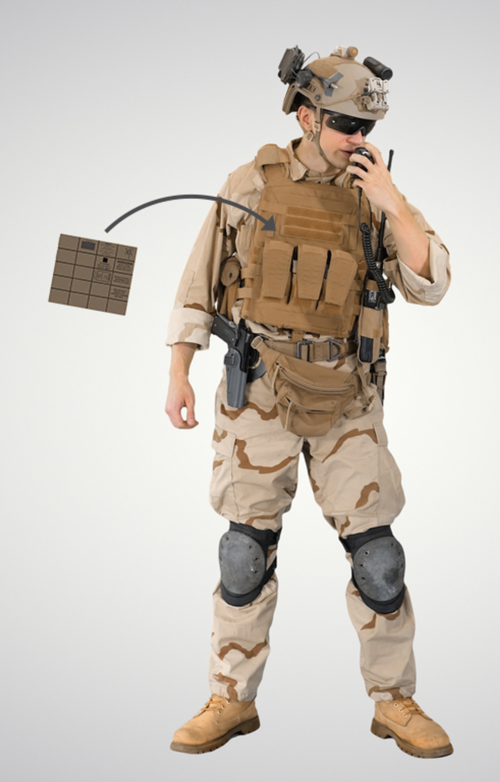
Speaking of capacity, knowing how much energy is left in the battery can be just as important as having enough available. For military users, an accurate understanding of remaining battery capacity supports mission planning and reduces the risk of unexpected equipment shutdowns. Digital state-of-charge information gives users a clearer picture of available energy, rather than requiring them to estimate it.
This has implications beyond the individual user. When commanders and logisticians can see accurate state-of-charge data across a unit, they can make better decisions about resupply and mission planning, rather than relying on fixed battery-change intervals that may be overly conservative or, in some cases, insufficient.
An example in practice
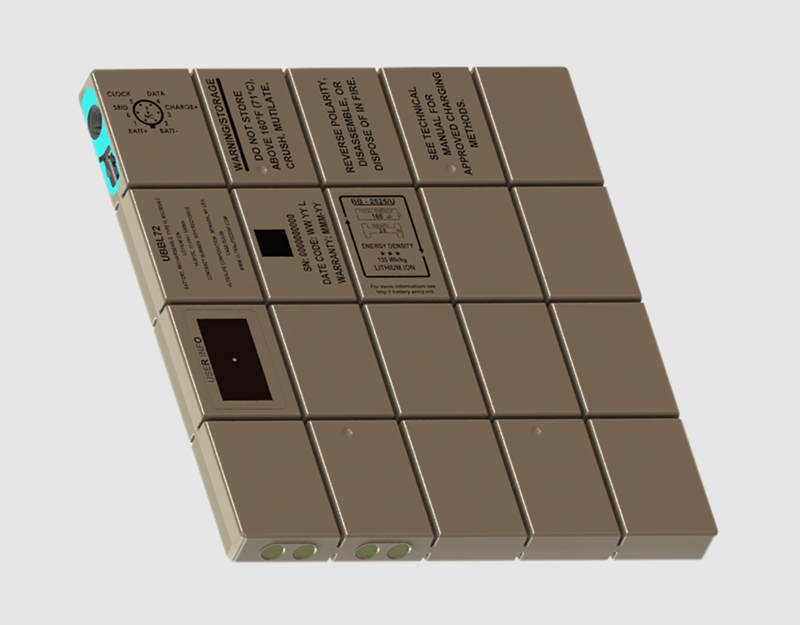
Ultralife’s UBBL72 conformal wearable battery illustrates how these considerations come together. It provides around 55 percent more energy than the company’s earlier UBBL35 model, rated at up to 166.5Wh compared to 108Wh, while adding only about 220g. It also offers wider environmental operating limits, USB charging, IP67 environmental protection and a digital state-of-charge display.
For engineers evaluating wearable power options, this combination of features, rather than a single headline capacity figure, determines whether a battery is genuinely suited to dismounted operations. A battery that adds meaningful energy without a proportional weight penalty, while also improving environmental protection and giving users visibility of remaining charge, addresses several requirements at once rather than optimizing for one at the expense of the others.
As electronic systems become more central to dismounted operations, portable power will continue to shape their effectiveness. The challenge is unlikely to be solved simply by producing batteries with ever-greater capacity. Wearable power must balance energy availability with the operational realities of managing that energy, along with the ruggedness, environmental performance, and usability demanded by military applications.
For defense engineers and procurement teams, wearable power is no longer a peripheral consideration. It is becoming part of the wider mission capability that determines how effectively personnel can use the systems they depend on.