By Mark Radford, chief technology officer, Blighter Surveillance Systems
Recent conflicts in the Middle East and Ukraine have highlighted the challenge of radar detection of low-altitude and one-way attack drones that fly ‘below the radar’ at altitudes under 100 m, taking advantage of ground clutter reflections and radio propagation fading effects. These real-world issues conceal small air targets beneath the larger clutter returns and weaken the radio signal.
While low-frequency long-range air surveillance and counter-UAS radars are essential in a layered drone detection system and offer good capability for high-flying drones, their ability to detect low-flying and near-surface targets is often compromised. Why? Because they simply cannot avoid the dramatic fading effects of multipath when scanning the horizon and cannot consistently remove significant ground clutter.
This article examines how advanced Ku-band sensing, electronic scanning array antennas, micro-Doppler waveforms, and sophisticated clutter-suppression technologies can minimize radio multipath fading and remove significant ground clutter, providing a COTS solution for detecting these low-flying and one-way attack drones.
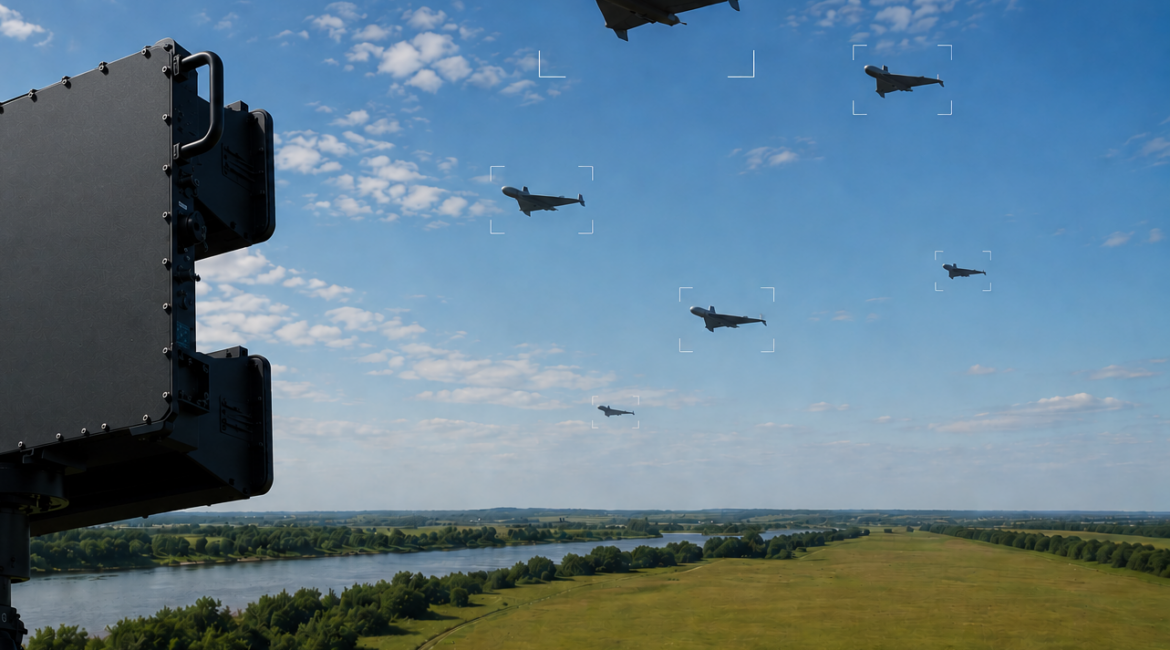
Radar remains a detection system immune to weather, light, and sound conditions, and, with careful design, can also avoid detection by adversarial electronic sensing. With clever engineering and some degree of ingenuity, near-surface targets such as first-person-view (FPV), fiber-optic, and Shahed-type winged drones – even those flown at 50m or less tracking the terrain – can be successfully detected, classified, and tracked by radar.
Ground Clutter Removal with ESA & Micro-Doppler Signal Processing
Ground clutter is the massive radar reflection returned by everything on the ground and not moving. This can include mountains, hillsides, buildings, trees, vegetation, fences, signage, power lines, and other infrastructure. Anything that stands above the ground can reflect radar energy – often surprisingly efficiently – and it does not have to be metallic.
To detect a drone 5km away with a radar cross-sectional area (RCS) of 1 m² in an area with buildings or a hillside in view would typically require illuminating a total volume of over 1 million cubic meters to detect that tiny drone. The radar must discriminate that 1 m² moving target alongside a radar reflection potentially 115,000 times larger.
Clearly, ground clutter is a major radar challenge, which is why classic air surveillance radars and many C-UAS systems point upward to illuminate air targets and avoid this problem.
Modern non-rotating electronic systems and digital signal processing (DSP) platforms allow the ubiquitous Fast Fourier Transform (FFT) to provide Doppler discrimination, the ability to distinguish different types of motion or targets by their frequency signatures.
A large ‘micro-Doppler’ FFT can segment the zero-Doppler (no motion) radar return from ground clutter within a Doppler bin equivalent to a tenth of 1km/hr. or less.
Electronic-Scanning Array Antennas Avoid Clutter Spreading
While modern DSP platforms allow this level of Doppler fidelity, mechanical rotation of classic single-antenna radars adds both incoming and outgoing Doppler components to the otherwise very narrow zero-Doppler ground-clutter measurement. This clutter spreading can easily obscure a 1 m² target, such as a drone.
Electronic-scanning array (ESA) antennas provide many individual beam positions to deliver the volumetric coverage needed, but each beam is static. With no Doppler spreading, the radar can achieve remarkable ground-clutter rejection, allowing the 1 m² target in 115,000 m² of clutter to be easily discriminated.
Several ESA architectures exist, but they all produce symmetrical transmit and receive beams, with energy tightly focused on the area of interest. Other staring array technologies, such as holographic radars, also have no mechanical rotation. Still, they illuminate large areas of ground clutter asymmetrically, making clutter rejection considerably harder for near-surface detection.
Rejecting ground clutter while detecting low-flying drones requires an elegant, highly complex solution using ESA antenna technology and Micro-Doppler signal processing. It also requires engineering excellence to preserve the fidelity of tiny target signals across the entire radar system, especially in the DSP.
Using Ku-band Radar to Reduce Radio Multipath Fading (RMF)
Anyone who has driven down a long highway listening to FM radio slowly fading in and out, and eventually fading to nothing, has experienced Radio Multipath Fading (RMF). It affects almost all ground-based communications systems, and height is the best mitigating factor.
Radar is another communication system, with a twist. It suffers RMF from the radar to the target, and then the reflected signal returns to the same radar receiver. This creates a double-fading effect that acts like a brick wall and can severely limit maximum detection range unless carefully managed.
While RMF is best known for its fading effects, it has one upside: the same direct-indirect phasing effect can enhance the signal under certain conditions. With careful design of radar deployment height, it can improve target detection range by allowing the radar signal to reach its normal signal-to-noise limit before the catastrophic effects of RMF overwhelm it.
While RMF affects all ground-based communications systems, operating frequency can significantly affect how quickly fading becomes a problem.
Ku-band radars, operating typically in the 15 to 17GHz dedicated radar bands, have the shortest wavelengths of typical longer-range government/military grade radar systems. This short wavelength of just 2cm is easiest to manage for RMF mitigation simply by elevating the radar a few meters above the ground. RMF will still occur; however, the fade periods are shorter, allowing target trackers to ‘join the missing plots, ‘ and the distance where near-ground fading becomes terminal can be pushed out beyond the signal-to-noise limitations of the same radar.
Blighter Surveillance Systems has implemented these techniques in its COTS ground-based radars, including its A400 and B400 2D radars and its A800 4D multi-mode radars, to protect against low-flying and one-way attack drones. These systems are deployed as part of a layered drone detection system by the US Air Force, at several international airports and by multinational forward operating bases in the Middle East.
Mark Radford has worked in the radar industry since 1985, initially as a designer of high-performance signal processing solutions for naval radar systems and later as a system designer and development manager. Since joining Blighter in 2000, Mark has been responsible for specifying, designing, and developing Blighter electronic-scanning array radars. The discovery of North Korean winged drones along the Korean demilitarised zone (DMZ) in 2014 kick-started Blighter’s development of its Ku-Band ground radar system and later a complementary C-UAS system called AUDS.