Breakthrough 7-month concept-to-water demonstration: unlimited USV on-station time, extended reach, distributed maritime operations for the US Navy and Allies
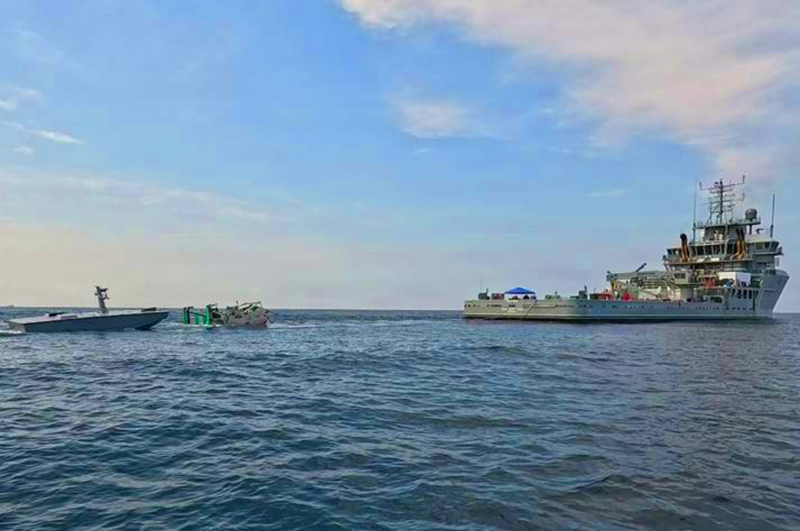
Maritime Tactical Systems, Inc. announced it successfully refueled a USV at sea. A joint Navy-industry team achieved the fuel transfer using a specially designed Sealartec™ Autonomous Replenishment at Sea (A-RAS) refueling system deployed from the stern of a surrogate platform. The A-RAS transferred fuel to a MARTAC Devil Ray® T38 owned by the Naval Air Systems Command Naval Air Warfare Center Weapons Division (NAWCWD) Blue Water Instrumentation (BWI) program.
The demonstration was achieved within seven months of the concept’s first development and delivered on a timeline conventional development and contracting paths do not produce. MARTAC, NAWCWD’s BWI program and Sealartec worked as a single integrated team, backed by contracting authorities built for speed.
During the August demonstration in waters off Joint Expeditionary Base Little Creek-Fort Story, Virginia, a Navy-owned MARTAC Devil Ray® T38 was repeatedly captured, refueled, and released while underway using Sealartec’s towable capture and connection device (TCCD), a robotic refueling system towed astern of the training support vessel USNS Vindicator (TSV 5). The team ran dozens of full-cycle capture, refuel, and release evolutions as well as pier-side events, and transferred a total of 400 gallons of fuel. In the days leading up to and including the demonstration, the system completed approximately 100 connection cycles.
Following extensive market research, NAWCWD selected the Devil Ray T38 for its stability and endurance. The T38’s patented catamaran hull form provides both the steady sensor platform BWI needs for range instrumentation and the precise alignment the TCCD requires to capture and connect. That stability is what made repeated underway refueling achievable.
U.S. Fleet Forces Command, Naval Surface Warfare Center Dahlgren Division, and Naval Surface Warfare Center Carderock Division sponsored the demonstration, which brought together BWI, BWI’s Future Capabilities Office fleet management team, MARTAC, and Sealartec. The Littoral Combat Ship Mission Modules Program Office (PMS 420) and the Navy’s Portfolio Acquisition Executive for Robotics and Autonomous Systems provided the contracting support that let BWI partner directly with both companies. MARTAC delivered on the timeline in part because its Naval Sea Systems Command Production Other Transaction Authority (P-OTA) compressed seven months of development into demonstrated capability.
“Working directly with our industry partners allowed us to bring the platform, control systems, operators, and engineers together as one integrated team. We could make changes, test them on the water, and iterate quickly based on what we observed,” said Spencer Holloway, director of BWI’s Future Capabilities Office.
“At industry conferences, we hear a lot of talk about how defense organizations want to adapt to the rapid pace of technology by streamlining procurement and operating more like agile startups,” said Amitai Peleg, CEO of Sealartec. “BWI didn’t just talk about that mindset; they demonstrated it.”
Karl Van Deusen, MARTAC’s Senior Vice President for Federal Business Development & Government Relations, credited the government team and Sealartec for the outcome. “Testing together in an operational environment allowed the team to identify improvements, apply lessons learned and refine future concepts of operation for unmanned maritime systems,” Van Deusen said. “MARTAC’s contractual relationship with BWI is a model for how industry and Government can learn and iterate together at speed. Our hats are off to Spencer Holloway and his team.”
Every time an unmanned vessel has to return to port for fuel, the fleet loses coverage. At-sea refueling breaks that constraint, converting the USV from a sortie-limited asset into a persistent one, and extending the reach of distributed maritime operations without adding crewed support ships or putting sailors into higher-threat waters.
The next step in advancing the autonomous refueling capability is refueling across distance. Seamus Flatley, MARTAC’s Chief Growth Officer and a former naval aviator, explained that utilizing airborne tankers to refuel strike fighter aircraft launching from an aircraft carrier extends the range and endurance of the carrier strike group’s air wing. He noted that “applying this same type of capability to lengthen the range and endurance of unmanned platforms extends the reach and lethality of a hybrid fleet.” To that end, MARTAC’s Leviathan T82, scheduled for delivery in Spring 2027, is being developed as a mid-size workboat, with a cruising range of 4,000 nautical miles, to act as a tanker on the seas, providing autonomous USV-to-USV refueling for all properly configured USVs.