
To detect and neutralize threats from submarines to outer space we need advanced edge computing solutions that are rugged, reliable and AI capable.
By Terry Santel and Todd Prouty
The United States faces an increasingly complex landscape of global threats from hypersonic missiles to space-based systems. Against this backdrop, the Golden Dome initiative seeks to create a defensive shield capable of protecting the U.S. from a broad spectrum of threats. It employs a multilayered, multi-domain approach that extends from under the sea to outer space. Ruggedized edge computing is a cornerstone technology that will help make this initiative possible.
Announced January 27, 2025, by President Trump, the Golden Dome initiative calls for the U.S. military to build the system (then called the Iron Dome for America) in stages within the next three years.
Unlike Israel’s Iron Dome, which intercepts short-range rockets primarily during their terminal phase, Golden Dome is designed to detect and neutralize threats at every stage of flight. It’s not simply about shooting down missiles as they approach the United States; it’s about monitoring and having options for acting on the entire trajectory from left of launch to impact. The Golden Dome will identify threats early and execute defensive measures with millisecond precision. The system aims to cover the full spectrum of threats, which includes intercontinental ballistic missiles, hypersonic missiles, cruise missiles, unmanned swarms, and even potentially hostile satellites or other non-kinetic space-based systems.
Taking defense to a new level
The key tenet of the Golden Dome is that it’s a defensive system, not an offensive one. The objective is to protect the homeland, not project force. The system needs to monitor, detect, identify, and neutralize threats from China, North Korea, Iran, or any actor that might seek to challenge our security. These threats can come from virtually anywhere in the world.
The breadth of these threats is what makes Golden Dome so technically challenging. Historically, U.S. missile defense programs focused on specific threats from defined locations. Now, the system must be prepared to respond to emerging technologies, improvised tactics, and unpredictable vectors — from submarines lurking near the coastline to swarms of unmanned aerial systems entering U.S. airspace. The pace of technological change means defenses must be able to respond to today’s threats and adapt quickly to those of tomorrow.
When every millisecond matters
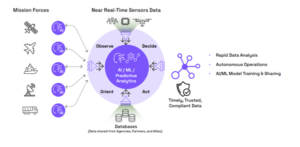
One of the most pressing challenges of the Golden Dome is computing. The system will rely heavily on artificial intelligence to process vast quantities of sensor data and make rapid recommendations. At hypersonic speeds, every millisecond counts. The initiative must integrate high-resolution radar, electro-optical/infrared sensors, acoustic sensors, and other intelligence platforms, then incorporate their outputs into actionable insights. Processing this massive data influx in real time is impossible with traditional centralized computing infrastructures.
The amount of data coming in from all the sensors is more than a single data center can ingest. The solution is computing at the edge. Ruggedized edge computing enables processing to occur locally, near the source of the data. This approach reduces latency, mitigates bandwidth constraints, and ensures that critical decisions can be made even when communications links are limited or contested. Edge systems perform real-time sensor fusion, AI-driven inference, and local decision support, while still feeding high-value intelligence back to central command nodes for coordination and broader situational awareness.
Mobile solutions demand ruggedized computing
Golden Dome’s compute platforms are expected to operate in some of the most extreme conditions imaginable. These include arctic cold, desert heat, high humidity, and intense vibration on vehicles and airborne platforms. These systems must also be resistant to electromagnetic interference and be able to maintain operation in contested electronic environments.
Ruggedized products are essential. Crystal Group’s offerings employ conduction-cooled designs, sealed electronics, and tamper-resistant housings to ensure their systems function reliably in these extreme conditions.
Distributed processing reduces latency
Rugged edge computing does more than provide environmental robustness. It also enables distributed processing. Golden Dome must distribute computations across a network of nodes, each capable of performing independent analysis while sharing critical intelligence across the system. This approach supports real-time AI applications, a critical component of modern missile defense.
By running inference locally rather than relying on a remote cloud server, systems can identify threats, calculate trajectories, and provide response recommendations within milliseconds. AI tools can significantly compress the time between threat detection and response ⏤ helping decisions be made in seconds rather than minutes. This is a crucial capability against hypersonic and other high-speed threats.
As compute capabilities move closer to the point of action, cybersecurity and data protection become essential. Systems must feature secure boot protocols, pre-boot authentication, and encryption aligned with security standards. Selection of Department of War (DoW)-approved Type 1 or Commercial Solutions for Classified (CSfC) alternatives are major trades that must be decided upon early in the program.
Constant evolution prevents obsolescence
Edge computing supports robust data management. Golden Dome’s architecture must prioritize and synchronize data effectively to ensure that mission-critical information reaches decision-makers without delay. Less urgent data is stored and transmitted opportunistically. High-speed NVMe storage, intelligent caching, and secure tiered data synchronization are key to enabling swift, reliable dissemination of intelligence across the system.
Partnerships with commercial technology providers are critical to sustaining the initiative. GPUs, AI accelerators, and high-performance processors continue to evolve rapidly in the commercial sector. Leveraging these advancements is vital to keeping Golden Dome ahead of emerging threats.
Systems must be designed to allow for modular upgrades. The latest processors or AI accelerators need to be swapped in without redesigning the entire system. This plays into Crystal Group’s strength of designing robust systems at the forefront of technology that can handle processing, power, and cooling upgrades necessary to prevent obsolescence. The hardware may be ruggedized to last 15 years, but the technology inside needs to be refreshed in a timely manner to keep pace with adversaries.
Multi-domain integration solves logistical challenges
The Golden Dome initiative is unique in its approach to multi-domain integration. Systems must operate across space, air, land, and maritime domains, coordinating multiple military branches and sensors. This presents both technical and organizational challenges. Space sensors, ground-based radars, airborne platforms, and naval assets all need to communicate and share data seamlessly. They must maintain this interoperability while ensuring security across multiple classifications.
Ruggedized edge platforms are crucial in enabling this multi-domain coordination. By providing localized processing and intelligence fusion, edge nodes can generate actionable insights for each domain while contributing to a shared, distributed picture of the battlespace. Edge computing transforms raw sensor streams into a coherent, real-time operational picture that can drive both automated responses and human decision-making.
A phased approach to completion
Development and deployment of Golden Dome is expected to unfold in phases over the next decade. When it was first announced, the ambitious goal was to have the Golden Dome running by the end of 2029. Some estimates suggest it may extend beyond that goal before the entire network is fully operational. Initial efforts will focus on critical regions and high-priority threats, gradually expanding to achieve full coverage.
This phased approach allows for technology insertions, iterative improvements, and adaptation of emerging commercial and defense innovations. For companies involved in the initiative, staying ahead of the technology curve is paramount. The companies providing compute solutions need to be in lockstep with AI and processor technology development. If a company falls behind, there is a risk that the entire system becomes obsolete before it’s even fully deployed.
The initiative represents a convergence of defense engineering, high-performance computing, and systems integration at a scale never attempted. While many challenges remain, the potential payoff is substantial. Golden Dome promises to provide the United States with a resilient, adaptive, and rapid-response defensive shield capable of countering the full spectrum of modern threats. Ruggedized edge computing is not simply a supporting element; it is the backbone that enables this ambitious vision.
The Golden Dome demonstrates how advanced computing, intelligent automation, and ruggedized engineering can be harnessed to protect not just territory, but the future of national security.
Terry Santel is the marketing manager and Todd Prouty is the strategic partnerships director at Crystal Group.