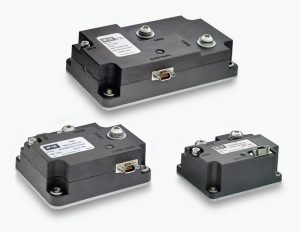

Fraunhofer IPMS presents Li-Fi TinySpot, a miniaturized, energy-efficient optical transceiver for wireless data communication in power-limited applications such as sensors, wearables, and embedded devices. The transceiver supports bidirectional full-duplex communication at data rates of up to 20 Mbps over distances from a few centimeters to several meters. Its compact form factor, low power consumption, and UART and SPI interfaces make it easy to integrate into space-constrained systems such as Health and Usage Monitoring Systems and support the modernization of legacy IrDA interfaces.
Across industries, devices are becoming smaller, more mobile, and energy‑constrained, yet still require reliable, interference‑free data links. Conventional wired and radio-frequency-based interfaces often struggle in tight installation spaces, EMI‑critical environments, and with limited battery capacity. Li‑Fi TinySpot addresses these challenges with an ultra-low-power, miniaturized optical transceiver that integrates into sensors, wearables, and compact embedded systems. This enables manufacturers to extend device runtime, simplify design, and maintain stable data transfer under demanding industrial conditions.
Low power consumption and a space-saving design
- Ultra-Low Power Consumption: With a power consumption as low as 5 mW, Li-Fi TinySpot extends battery runtime and reduces operating costs in devices where every milliwatt counts.
- Compact Design: Measuring just 15 mm × 21 mm × 3.3 mm and weighing only 1 g, Li-Fi TinySpot supports compact and densely integrated designs for sensors, handheld devices, and wearables.
- Flexible Operating Range: Depending on the configured transmit power and field of view, the system supports distances ranging from a few centimeters to several meters.
- Safe Operation: Class 1 eye safety enables operation without additional protective measures.
- Immunity to Electromagnetic Interference: Since Li-Fi uses light instead of radio waves and does not require long wired electrical signal connections, the technology is suitable for EMC-critical environments.
- Easy Integration: Standard interfaces such as UART and SPI simplify integration into microcontroller- and FPGA-based systems.
- Low Latency: A low transmission latency of 170 ns supports responsive data exchange in embedded control and sensor applications.
- IrDA Compatibility: Support for SIR, FIR, and VFIR facilitates the modernization of existing infrared interfaces without introducing radio communication.
This makes Li Fi TinySpot particularly attractive for battery-powered sensor systems designed for extended operating lifetimes, as well as for embedded controllers and detachable modules that require reliable contactless communication. Its low weight of only 1 g makes it easy to integrate into moving, rotating, or interchangeable components. You can mount the transceiver directly on printed circuit boards or integrate it into miniature modules and sealed housings without bulky optics or complex mechanical assemblies.
Designed for Demanding Embedded Applications
Its contactless optical interface makes Li Fi TinySpot suitable for applications where electrical contacts, radio communication, or conventional cabling are impractical, including:
- Embedded and board-to-board communication: Contactless links between stacked PCBs, sensor boards, or interchangeable modules inside devices.
- Miniaturized sensor systems: Data connections for small sensor nodes in confined spaces, such as handhelds for logistics, laboratory equipment, precision mechanics, health and usage monitoring systems or condition monitoring applications.
- Detachable or rotating modules: Replacement of wear-prone micro connectors or slip rings in tool heads, small rotary stages, or compact positioning systems.
- Sealed and hygienic housings: Communication through small optical windows in hermetically sealed or easy-to-clean devices, where open electrical contacts are undesirable.
- Interference-sensitive electronics: Environments with strong electromagnetic fields or dense electronics, where radio technologies or long copper traces are difficult to apply.
“Li Fi TinySpot shows how optical communication can be scaled down for compact embedded systems,” says Dr. René Kirrbach, Group Leader for Li Fi at Fraunhofer IPMS. “Its contactless optical interface enables reliable data connections with low power consumption in tight spaces, where conventional connectors are unsuitable due to wear, contamination, or mechanical constraints.”