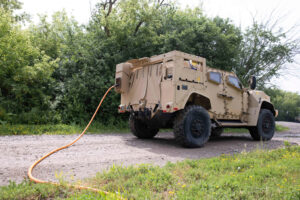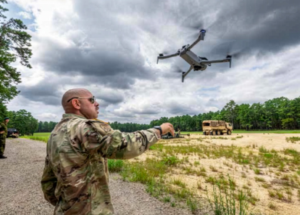
The energy storage problem at the heart of military electrification is not simply about capacity. It is about power and the ability to absorb and deliver energy in seconds, not hours, without degrading under repeated punishment. This distinction matters enormously when the platform in question is an armored hybrid fighting vehicle drawing burst power for active protection systems, or a tactical drone that needs to recharge as fast as possible between sorties at a forward operating base to decrease critical downtime.
Most lithium-ion battery technologies today are optimized for energy density, which translates to range, rather than power density. These technologies have low input and output power, and therefore discharge slowly and can recover only a small amount of energy. A lower power output (low C-rate) also means that a heavy vehicle cannot be moved quickly under electric power, or that a drone accelerates more slowly than desired.
In both heavy-duty vehicles and drones, space and weight are significant, and it is therefore crucial to use a battery technology that delivers strong results in both respects.
For some applications, a long service life or cycle stability is important to minimize the risk of failure. With most battery technologies, this cycle stability decreases as fast charging and discharging capabilities increase.
A Different Kind of Battery Company
Nyobolt was founded in 2019 by Professor Dame Clare Grey and CEO Dr. Sai Shivareddy, drawing on more than a decade of electrochemical research conducted at the University of Cambridge. The company’s core insight was specific: that Niobium Tungsten Oxide (NWO), when used as an anode material, enables fundamentally different battery behavior, faster and symmetrical charge/discharge acceptance, lower internal resistance, and dramatically extended cycle life. In 2025, its high-power cells entered serial production for integration into various customer applications across several industries, both inside and outside the defense arena.
The performance figures are not incremental. Nyobolt’s cells charge from 0 to 100% in under 6 minutes and achieve charge and discharge rates of 6C to 30C, with a rated cycle life of up to 25,000 cycles. This figure dwarfs conventional lithium-ion technology and carries direct implications for platform availability and total cost of ownership. A 2024 public demonstration of a 35kWh EV concept validated this performance in a real-world vehicle context, showing the battery charging in less than 5 minutes. That demonstration also highlighted a secondary advantage: the ability to use a smaller, lighter battery pack without sacrificing usability, a design principle with obvious resonance for weight-constrained military platforms.
Hybridisation of Military Ground Vehicles
Next-generation military vehicles, whether directed energy weapons, light tactical platforms, infantry fighting vehicles, or logistics variants, are increasingly expected to carry significant electrical loads. Electrification or hybridisation is one logical response, but its value is only as good as the energy buffer it provides.
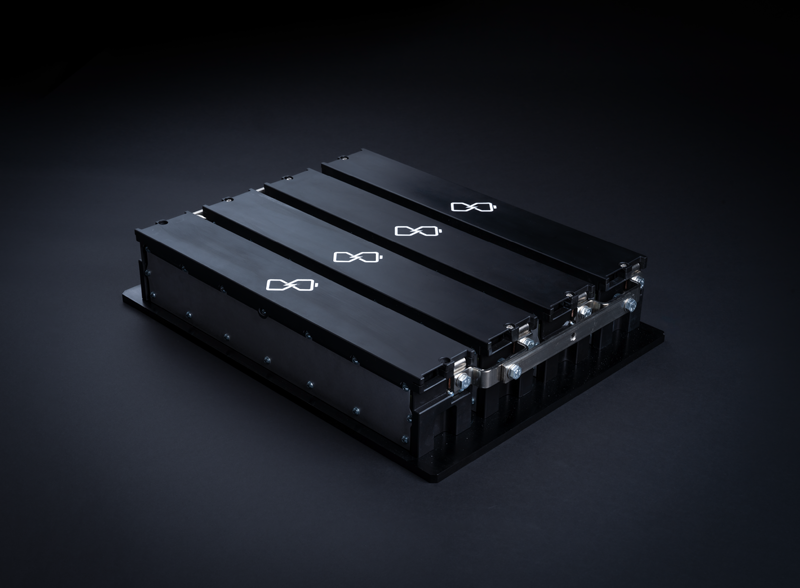
A hybrid military vehicle needs a battery system that can rapidly absorb regenerative energy during braking, deliver sustained burst power to high-draw systems without voltage sag, and do both repeatedly throughout a mission cycle without requiring a maintenance window. Current batteries often prioritize energy density over power density and therefore can’t deliver the charge and discharge power needed in hybrid military vehicles without oversizing the battery. If space for an additional battery is limited, for example, due to a retrofit strategy, a high-power technology, such as Nyobolt’s ULTRA module, is required. It supports voltage configurations from 48V to 1000V through series and parallel connection, offering integration flexibility across diverse military platform architectures. A continuous 10C charge and discharge rate and a 30C peak provide the power headroom that high-draw military electronics and powertrains demand. The module is liquid-cooled and compatible with Nyobolt’s battery management system, which carries ISO 26262 ASIL-C functional safety certification.
The chemistry also operates down to -30°C, a specification that matters for platforms deployed in northern European and Arctic environments, where conventional lithium-ion cells suffer significant performance degradation at low temperature.
Electric and Hybrid Drones: The Recharge Constraint
The proliferation of unmanned aerial systems across every domain of modern conflict is driving an increasing demand for suitable battery systems. A drone that takes hours to recharge between sorties is not operationally equivalent to one that takes under ten minutes. At forward operating bases with limited power generation, recharge time becomes a mission rate constraint, a ceiling on how much persistent ISR, strike, or logistics support can be maintained.
 For fully electric tactical drones, battery chemistry determines this ceiling almost entirely, as slow recharge rates create mission-critical downtime. Nyobolt cells capable of accepting high charge rates compress the downtime to minutes, enabling higher sortie rates and more flexible deployment of smaller drone packages without expanding the logistical footprint. Combined with operation across a -30°C to high-temperature range, Nyobolt’s chemistry is compatible with the environmental envelope of tactical UAV operations across demanding theatres.
Hybrid drone architectures that use combustion engines for sustained endurance but rely on battery buffers for burst performance during take-off, payload activation, or evasive maneuvers present a related but distinct requirement. The buffer needs to be small, light, and capable of delivering high peak power reliably across thousands of cycles. This is precisely the performance profile where Nyobolt batteries have a structural advantage over alternatives.
From Cambridge to the Field
Nyobolt is not a defense company by heritage. Its initial commercial focus has been on high-performance electric vehicles, autonomous mobile robots, and industrial fast-charge applications, markets that have validated the core technology under demanding conditions and driven the qualification milestones that also matter to defense integrators. Thanks to a diverse supply chain both within and outside China, it is possible to meet a wide range of market requirements, which opens the door to battery projects in the defense arena.
The question for defense platform designers is concrete: if the energy storage constraints on your next hybrid vehicle or UAV program could be reimagined to enable faster recharge, higher burst power, and 25,000-cycle durability, what would you build differently? Nyobolt’s answer to that question is no longer theoretical. The cells exist, they are certified, and they are in commercial production. Give us a call, and we will show you how our performance batteries can eliminate all energy storage constraints on your platforms.